
Emergency Guides
Dishwasher Leaked Overnight and Flooded the Kitchen — Now What?
The puddle in front of the dishwasher is the smallest part of the problem. The water you cannot see is under the cabinets and the flooring.
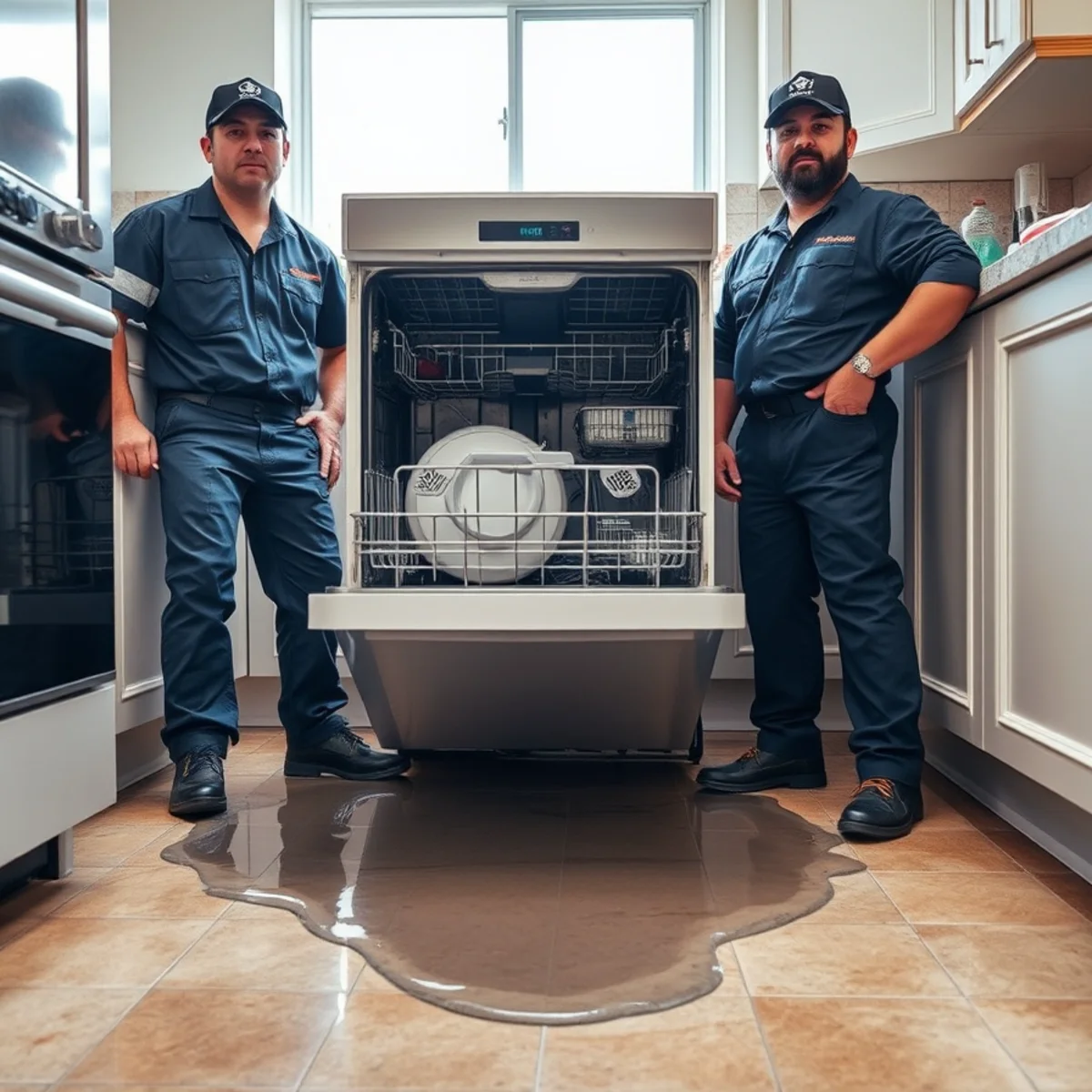
The short answer
Switch the dishwasher off at the breaker and close its supply valve under the sink, then check inside the adjacent cabinets and under the toe-kick rather than looking at the floor. Most dishwasher water goes backwards into the cabinet run and under the flooring, where it stays for weeks.
Dishwasher leaks are deceptive in a way that almost no other appliance failure is, because the dishwasher sits in the worst possible place — recessed under a countertop, surrounded by cabinetry, on top of the flooring.
Water that escapes goes backwards and sideways into the cabinet run and under the floor before any of it appears in front of the machine. By the time you see a puddle, the hidden part has been happening for a while.
Dealing with this right now?
Crews dispatched within 60 minutes — on-site in 60–90 minutes, anywhere in Fullerton. Call and we will talk you through the first two minutes while a crew is dispatched.
- 60-minute dispatch, anywhere in Fullerton
- IICRC-aligned · licensed & insured
- Direct insurance documentation
First: Stop It And Cut The Power
Turn the dishwasher off mid-cycle and switch off its circuit at the breaker. A dishwasher is a hardwired or plugged appliance sitting in water — treat it as electrical.
Then close the water supply. Dishwashers are fed from a valve under the kitchen sink, usually a small saddle valve or angle stop on the hot line. If you cannot find it or it will not move, shut the house main.
Do not run the dishwasher again to 'finish the cycle'. Whatever failed will keep failing.
Second: Find Out How Far It Went
This is the step that determines whether this is a mop-up or a restoration job, and it needs to be done properly rather than by looking at the floor.
Open the cabinet next to the dishwasher and feel the side panel and the floor of the cabinet. Open the sink cabinet and check the base. Pull out the toe-kick panel if you can and look underneath — the void under a cabinet run is where dishwasher water goes and it does not drain out.
Check the flooring at the edges. Tile can look completely dry over a saturated substrate. Vinyl plank and sheet vinyl trap water underneath with nowhere to evaporate. Laminate swells at the seams and the edges lift, which is usually terminal.
If the kitchen backs onto another room, check the flooring on the other side of that wall. Water follows the bottom plate.
Why Cabinets Are The Expensive Part
Kitchen cabinets are largely particleboard or MDF with a finished face, and both swell irreversibly when they take on water. There is no drying that back.
The failure starts at the bottom — the cabinet base, the toe-kick, and the back panel. Those are the parts sitting in the water and they are also the parts nobody looks at.
The void under the toe-kick is the real problem area. It is enclosed, unventilated, and holds water for weeks. That is where mold starts in a kitchen, and it is why a dishwasher leak that seemed minor produces a musty smell a month later.
Where the damage is caught early, we can often dry the cabinet run in place by injecting dry air into the toe-kick void rather than removing cabinetry. That is a dramatically better outcome than replacing a run of cabinets, and it depends almost entirely on how quickly it is caught.
What Usually Fails On A Dishwasher
Worth knowing, because it affects whether this is a repair or a replacement — and whether it will happen again.
- Door gasket — perished or displaced, so water escapes at the front during the wash cycle. The most common and the easiest to fix.
- Supply line connection at the valve — a slow weep that runs every cycle for months before anyone notices.
- Drain hose — cracked, or a failed connection at the disposal or drain tee, which discharges grey water rather than clean.
- Pump seal or tub crack — usually terminal for the machine.
- Overfilling from a failed float switch or water inlet valve — the machine keeps filling and overflows the tub.
Grey Water Changes The Rules
A supply-side leak is clean Category 1 water. A drain-side leak is Category 2 grey water, carrying detergent, food waste and bacteria.
That distinction matters because it changes what can be saved. Category 1 water caught quickly usually means flooring and cabinetry can be dried in place. Category 2 raises the removal threshold — porous materials that absorbed it are more likely to come out, and the affected area needs cleaning and antimicrobial treatment rather than drying alone.
So one of the first things we establish is which side of the machine failed, and whether the water in the cabinet void is supply water or discharge.
What To Do Before Anyone Arrives
Photograph everything, including inside the cabinets and under the toe-kick if you can reach it.
Get everything out of the base cabinets — pans, cleaning products, anything stored on the cabinet floor. That both saves the contents and lets air get in.
Mop the visible water and open the cabinet doors. Do not put a box fan on it and call it done; you will dry the surfaces while the void and the substrate stay wet, which is exactly how these turn into mold jobs.
And do not pull the dishwasher out yourself if the flooring runs under it — dragging it can tear the vinyl or scratch the tile, and the appliance may still be connected.
How to Tell Where the Dishwasher Is Actually Leaking From
Five things fail on a dishwasher, and each one leaves water in a different place. Working out which before anyone arrives saves a service call and tells you whether this is a fifteen-dollar part or a replacement.
Pull the lower kick panel off — usually two screws — and look with a torch while the machine runs a short cycle. Almost every one of these is visible from there.
- Water pooling at the front edge of the door only: the door gasket has hardened or the door is out of adjustment. Cheapest of all the failures.
- Water under the centre of the machine, appearing during the wash cycle: the pump seal. Common, and usually worth repairing on a newer machine.
- Water at the right rear corner: the supply connection at the angle stop or the braided line. This is the one that leaks when the machine is not even running, and the one that causes the worst damage.
- Water at the left rear, only when the machine drains: the drain hose connection at the disposal or air gap. Often just a loose clamp.
- Suds across the floor with no component failure: dish soap in place of dishwasher detergent. It happens more often than you would think.
- Water inside the cabinet next to the dishwasher rather than under it: the water has already travelled, which means the leak has been going longer than today.
Frequently asked
Yes, if the leak ran for more than a short time. Tile can be completely dry on the surface over a saturated mortar bed, and vinyl traps water underneath with nowhere to go. A pinless moisture meter reading takes minutes and settles the question without lifting anything.
Not necessarily, and speed is the deciding factor. Caught early, a cabinet run can often be dried in place by injecting dry air into the toe-kick void. Once particleboard has swollen it cannot be restored, so the difference between calling on day one and day ten is frequently the difference between drying and replacing.
Usually not — that is the distinction most people are surprised by. A standard California homeowners policy covers the water damage caused by a sudden appliance failure, but treats the failed appliance as a maintenance item rather than covered property. A slow leak that ran for months may be denied as gradual damage, which is why the supply connection weeping quietly under a sink is the worst version of this problem.
The bottom line
Power off, water off, then look inside the cabinets rather than at the floor.
The visible puddle is the least of it. What matters is the void under the cabinet run and whatever is under the flooring.