
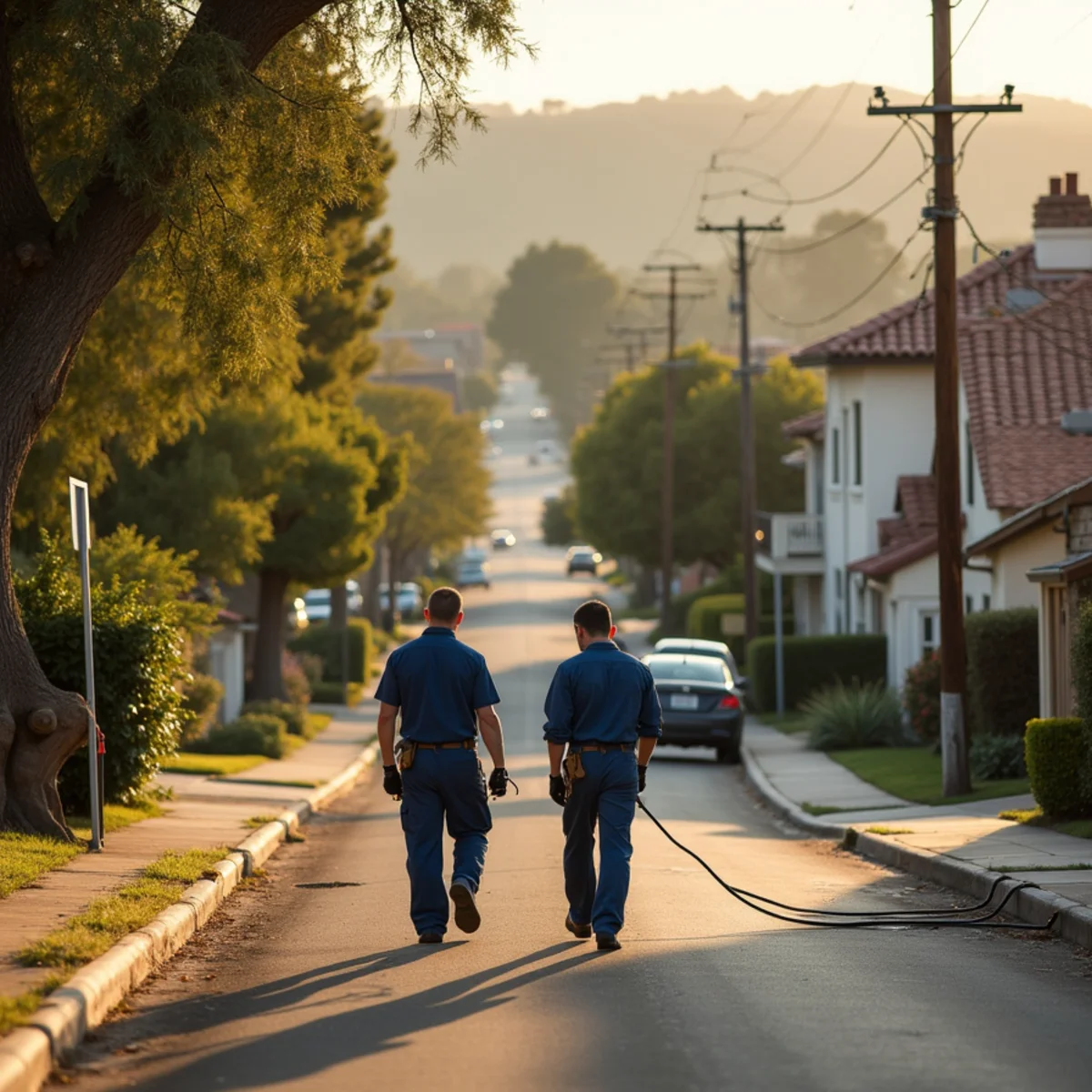
24 Neighbourhoods · 60-Minute Dispatch
Water Damage Restoration in Every Fullerton Neighbourhood
Downtown's century-old galvanized plumbing, Sunny Hills' slab leaks, Coyote Hills' storm exposure, Bastanchury's wind-damaged roofs. Different neighbourhoods, different failures — and we scope them differently.
- On-site in 60–90 minutes
- IICRC-aligned · licensed & insured
- Staged on 1500 S Raymond Ave
The local pattern
Four things drive water damage in this city
Age. Downtown, Lemon Park and the Heritage streets are full of 1920s to 1940s houses still running original or first-replacement galvanized supply lines. Galvanized corrodes from the inside out — it weeps, then it splits.
Slab-on-grade construction. The 1950s through 1970s tracts across Sunny Hills, Valencia, Commonwealth and West Fullerton were poured directly on expansive clay. The clay swells and shrinks every season, the slab moves, and copper cast into it abrades. Add Orange County’s hard water at 14 to 25 grains per gallon and you get pinhole leaks in copper that was fine for forty years.
Water from outside. Roughly 14 inches of rain a year, nearly all of it between November and March and concentrated in a handful of hard storms. Coyote Creek runs along the north and east edge of the city.
The city’s own infrastructure. Fullerton maintains around 420 miles of water main and estimates about half is more than fifty years old.
What Happens When You Call
From your call to equipment running, in Fullerton
The sequence is the same in every neighbourhood. What changes is what we expect to find when we arrive.
- 01
The call
Answered by a person, [object Object]. We ask what you can see, whether the water is still moving, and whether it has reached anything electrical — then talk you through shutting the water off if it has not been done.
- 02
Dispatch inside 60 minutes
A crew leaves within 60 minutes and is on site in 60–90 minutes anywhere in the city. Most Fullerton addresses are 10 to 15 minutes from our S Raymond Ave base.
- 03
Assessment and documentation
Water category established, moisture mapped across every affected material, and photographs and video taken before anything is moved. That evidence is what your adjuster works from.
- 04
Extraction and drying
Standing water out, unsalvageable material removed, then air movers and dehumidification placed to a calculated load — with daily readings until materials match a dry standard taken from your own building.
24 neighbourhoods
Choose your neighbourhood
Downtown Fullerton
1920s–40s historic core on the Fullerton Heritage register; the oldest plumbing stock in the city plus bar and restaurant commercial losses.
The Hill
Cal State Fullerton student-housing district; high rental turnover, shared housing, and frequent appliance-overflow jobs.
Sunny Hills
1950s–60s post-war tracts; original slab-on-grade construction now at peak slab-leak and galvanized-pipe failure age.
Raymond Hills
Mid-century homes on elevated terrain; our 1500 S Raymond Ave base sits in this orbit, making it our single fastest response area.
West Fullerton
1950s–70s tracts toward the Buena Park border; uniform construction era means simultaneous repipe demand across whole blocks.
East Fullerton
1960s–70s slab-on-grade tracts toward the Anaheim and Placentia borders; flat terrain on expansive clay that relies entirely on street drainage.
Golden Hills
Established 1960s family tracts; mature oak and sycamore canopy over original clay-tile sewer lines.
Amerige Heights
2000s–2010s master-planned community near downtown; newer homes with builder-grade components now in their first repair window.
Coyote Hills
Homes adjacent to the Coyote Hills golf course and creek corridor; the highest flood exposure in Fullerton plus clay-soil movement.
Bastanchury
Hillside custom homes on former citrus ranch land; the highest ground in Fullerton, with slope drainage, wind exposure and genuine freeze nights.
Rolling Hills
1960s–70s view homes on elevated terrain; wind-driven rain penetration and expansive clay-soil foundation cracks.
Orangethorpe
Commercial and industrial corridor along Orangethorpe Avenue with adjacent residential; retail, warehouse and light-industrial loss volume.
Valencia
1950s–60s entry-level tracts; some of the city's oldest post-war plumbing and the highest rate of galvanized-line failures outside downtown.
West Coyote Hills
Newer construction on former oil-field land; new-build component failures plus graded-slope drainage on engineered fill.
South Fullerton
1960s–70s tracts south of Commonwealth Avenue; flat terrain with clay-soil slab cracks and Coyote Creek drainage exposure.
North Fullerton
A mix of 1940s–50s ranches and 1960s–70s tracts; older sewer laterals and mature landscape root intrusion across two construction eras.
Lemon Park
Historic 1920s–30s homes near the old Pacific Electric lemon-packing district; the oldest plumbing in central Fullerton.
Chapman Woods
Mature tree-canopy streets near Chapman Avenue; root-invaded sewer laterals and aging irrigation systems on established lots.
Commonwealth
1950s–60s tracts along Commonwealth Avenue; original slab-on-grade homes now at peak repipe and water-heater replacement age.
Brookhurst
Dense 1960s–70s tracts with high rental density; frequent tenant-caused overflow and appliance-line failure jobs.
Gilbert
Family-oriented 1960s pocket near Gilbert Park; original systems in the active replacement window with copper at pinhole age.
Magnolia
1950s–60s tracts along Magnolia Avenue; among Fullerton's earliest post-war plumbing, now at the end of its service life.
Parks
1970s family tracts near Parks Junior High; original copper now at pinhole-leak age from Orange County hard-water buildup.
Euclid
Central pocket of 1950s–60s homes beside the Euclid Street commercial strip; mixed residential and small-commercial losses.
Questions
Serving Fullerton
Raymond Hills, at four to eight minutes — our staging point on S Raymond Ave sits in that orbit. Downtown Fullerton, The Hill and South Fullerton are all under ten minutes. Bastanchury, Rolling Hills and the Coyote Hills edge run twelve to eighteen depending on the route.
Because they were built in different decades on different ground. The 1920s–40s housing downtown runs galvanized supply lines that corrode from the inside. The 1950s–70s tracts are slab-on-grade on expansive clay, where hard water pits copper from within and soil movement abrades it from without. The hillside neighbourhoods take Santa Ana wind damage and slope runoff. Knowing which you are in changes what we check first.
Every neighbourhood, 24 hours a day, with crews dispatched within 60 minutes. Most Fullerton addresses are a 10 to 15 minute drive from our base rather than a trip in from another county.
If it was built between roughly 1950 and 1975 — which covers most of Sunny Hills, Valencia, Commonwealth and West Fullerton — almost certainly yes. Pre-war houses downtown and in the Heritage streets are more often raised foundations over a crawl space. The quickest test is to look for a crawl space access hatch or vents along the exterior wall near ground level; no vents usually means slab.
Slab leaks, by a clear margin, followed by water heater failures and washing machine supply lines. The slab leak volume is a direct consequence of the city's post-war housing stock sitting on expansive clay with hard water running through copper — three conditions that stack, and that most other Southern California cities do not have in the same combination.
It contributes to them. Orange County water runs roughly 14 to 25 grains per gallon, which deposits scale inside copper pipe. Flow turns turbulent around the deposits, and that turbulence drives pitting corrosion until a pinhole opens. It is a slow process, which is why the resulting leak weeps inside a wall for weeks rather than bursting in a way you would notice.
Water damage in Fullerton? We are already loading the truck.
Crews dispatched within 60 minutes — on-site in 60–90 minutes, anywhere in Fullerton. A real person answers the line at any hour, and we document everything your insurance adjuster will ask for.
- 60-minute dispatch, anywhere in Fullerton
- IICRC-aligned · licensed & insured
- Direct insurance documentation