
Problem Solving
How Pros Find Slab Leaks Without Tearing Up Your Whole Floor
Nobody should be jackhammering a floor to search. Here is the five-step process that narrows a slab leak to inches before any concrete is opened.
The short answer
Meter isolation first to confirm the leak and separate inside from outside, then thermal imaging to find the temperature signature, then acoustic correlation to pinpoint it to within inches, then pressure testing to confirm. Only then is the concrete cored — one small opening, not a trench.
The fear with a slab leak is the floor. People imagine a trench across the living room and a house full of dust.
That is what happens when nobody located the leak first. Done properly, detection narrows the failure to within a few inches and the concrete is opened once, in one small place.
Dealing with this right now?
Crews dispatched within 60 minutes — on-site in 60–90 minutes, anywhere in Fullerton. Call and we will talk you through the first two minutes while a crew is dispatched.
- 60-minute dispatch, anywhere in Fullerton
- IICRC-aligned · licensed & insured
- Direct insurance documentation
Step 1: Confirm It Exists And Isolate The System
Everything starts at the meter. Every fixture and appliance off, then watch the low-flow indicator. Movement means water is leaving the system.
Then close the house main and watch again. If the indicator stops, the leak is inside the building; if it keeps moving, it is between the meter and the house — a service line, not a slab leak, and a completely different job.
Next, isolate hot from cold. Closing the cold inlet valve at the water heater takes the hot system out of the equation. If the meter stops, the leak is on the hot side, which fits with a warm floor spot and is the more common failure.
This step alone rules out most of the possibilities in about twenty minutes and costs nothing but time.
Step 2: Thermal Imaging
An infrared camera reads surface temperature, and a slab leak changes surface temperature in a specific way.
A hot-water leak is obvious — a warm plume spreading through the slab from a point, visible through carpet, tile or vinyl. It reads like a heat map of exactly where the water is going.
A cold-water leak is subtler and shows as evaporative cooling: a cool signature spreading from a point as moisture draws heat out of the concrete.
Thermal imaging is fast and completely non-invasive, and it narrows a whole-house question down to a room and often a wall. It does not pinpoint, though — that is the next step.
Step 3: Acoustic Detection And Correlation
This is what turns a general area into a specific spot.
Water escaping a pressurised pipe through a small opening makes a distinctive sound — a hiss or a rush at a characteristic frequency — and that sound travels through the pipe, the concrete and the soil.
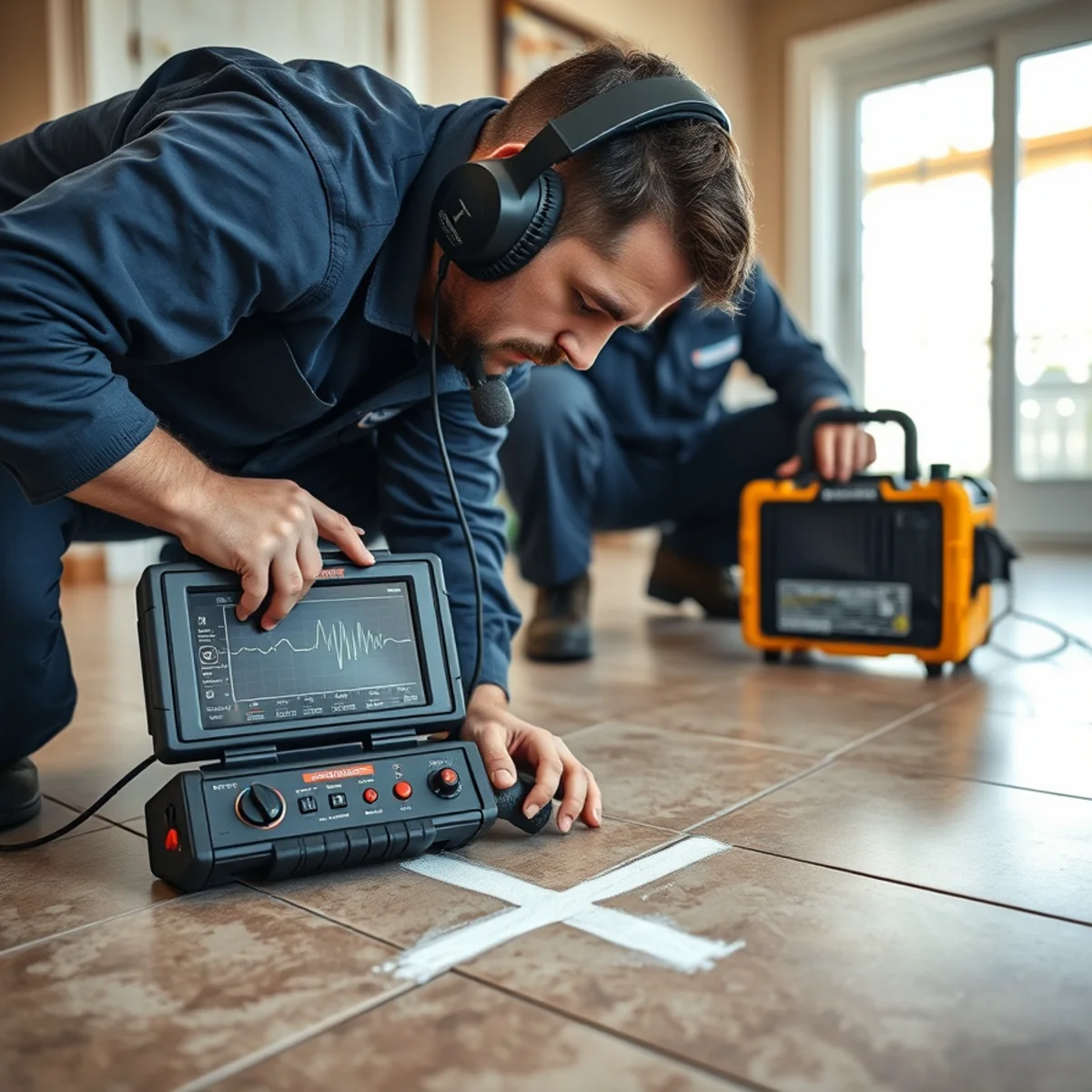
Ground microphones amplify it. A technician works across the floor listening for the point where the signal is loudest, which is usually directly above the failure.
Correlators refine it further by placing sensors at two accessible points on the same line and measuring the tiny difference in arrival time of the sound at each. Knowing the pipe material, diameter and the distance between sensors, the equipment calculates the position of the leak mathematically. On a good correlation that is accurate to within a few inches.
This is the step that saves the floor, and it is why detection is worth paying for separately from the repair.
Step 4: Pressure Testing To Confirm
Before concrete is opened, the finding gets confirmed rather than assumed.
Individual branches are isolated and pressure tested in turn — the line is charged and monitored for pressure drop. A line that holds pressure is not the problem; a line that drops is.
This matters because acoustic signals can bounce and mislead, particularly in a house with multiple lines running close together, and because a wrong location means a wrong hole.
Between the meter test, the thermal image, the acoustic correlation and the pressure test, four independent methods should be pointing at the same place before anyone picks up a saw.
Step 5: One Small Opening
The confirmed point is marked, the flooring is lifted locally, and the concrete is cored — typically an opening around a foot or two square rather than a trench.
The plumber exposes the pipe, confirms the failure, and repairs it. Then the slab is patched, the flooring goes back, and the drying begins.
Concrete holds moisture in its top layer and dries slowly — typically five to seven days with dedicated equipment, and longer if flooring trapped moisture for weeks before the leak was found. That drying is metered against a dry reference area rather than judged by feel.
Where the flooring is vinyl, laminate or engineered wood, it usually has to come up regardless so the slab can breathe. Carpet and pad can often be lifted, dried and reset.
What To Ask Before You Book
Three questions that separate a detection service from a demolition service.
What equipment do you use? You want to hear thermal imaging and acoustic correlation, not 'we listen with a stethoscope' and not 'we start where it is likely'.
What is the detection fee, and is it separate from the repair? A fixed detection price is a good sign. A company that only quotes a bundled figure has less incentive to be precise.
What happens if the location is wrong? Reputable operators stand behind a located point.
And one more: ask what the exposed pipe looked like once it is open. Visible pitting along the section means the system is at end of life rather than unlucky, and that changes whether a spot repair or a reroute is the sensible decision.
Four Questions to Ask Before Booking a Detection
The answers tell you whether you are hiring a locator or a demolition crew:
- What equipment do you use? You want thermal imaging and acoustic correlation, not a stethoscope and an educated guess.
- Is the detection fee separate from the repair? A fixed detection price means the technician is paid to be precise rather than to open your floor.
- How large an opening do you expect to make? A confirmed location means a cored hole a foot or two across, not a trench across a room.
- What happens if the located point is wrong? Reputable operators stand behind a marked location.
- And one to ask afterwards: what did the exposed pipe look like along its length? Visible pitting means the system is at end of life, not unlucky.
- If a company proposes opening the floor before locating the leak, get a second opinion before anyone starts cutting.
Frequently asked
With acoustic correlation on a good signal, typically within a few inches. Conditions affect it — deep slabs, multiple lines running close together, and high ambient noise all make it harder — which is why the finding is confirmed with pressure testing before any concrete is opened.
No. Detection is entirely non-invasive, and the concrete is opened only at the confirmed point — usually a single cored opening a foot or two across. A trench across a room is what happens when nobody located the leak first.
Usually, and that is a good thing. A fixed detection fee means the technician is being paid to be precise rather than to open the floor. Ask for the detection price up front — any honest operator will give you one before they arrive.
The bottom line
Meter, thermal, acoustic, pressure test, then one small hole. That is the whole sequence.
If someone proposes opening the floor before they have located the leak, get a second opinion.