
Emergency Guides
Toilet Overflowing? How to Stop It — and When It's Actually a Sewage Emergency
Stopping the overflow takes ten seconds if you know where to reach. Working out whether it is a clog or a main-line backup takes about a minute — and it changes everything.
The short answer
Push the flapper down inside the cistern to stop the flow immediately, or close the angle stop behind the toilet. Then run other fixtures: if they drain normally it is a clog in that toilet, but if several are slow or gurgling it is a main line backup and you should stop using water entirely.
A toilet overflow is one of two completely different problems wearing the same costume.
One is a clog in that toilet — annoying, containable, and mostly a cleaning job. The other is a backup in your main line, which means everything the house sends down is now coming back up, and it is a biohazard. Telling them apart matters more than the cleanup itself.
Dealing with this right now?
Crews dispatched within 60 minutes — on-site in 60–90 minutes, anywhere in Fullerton. Call and we will talk you through the first two minutes while a crew is dispatched.
- 60-minute dispatch, anywhere in Fullerton
- IICRC-aligned · licensed & insured
- Direct insurance documentation
First: Stop The Water, In Ten Seconds
Two options and either works.
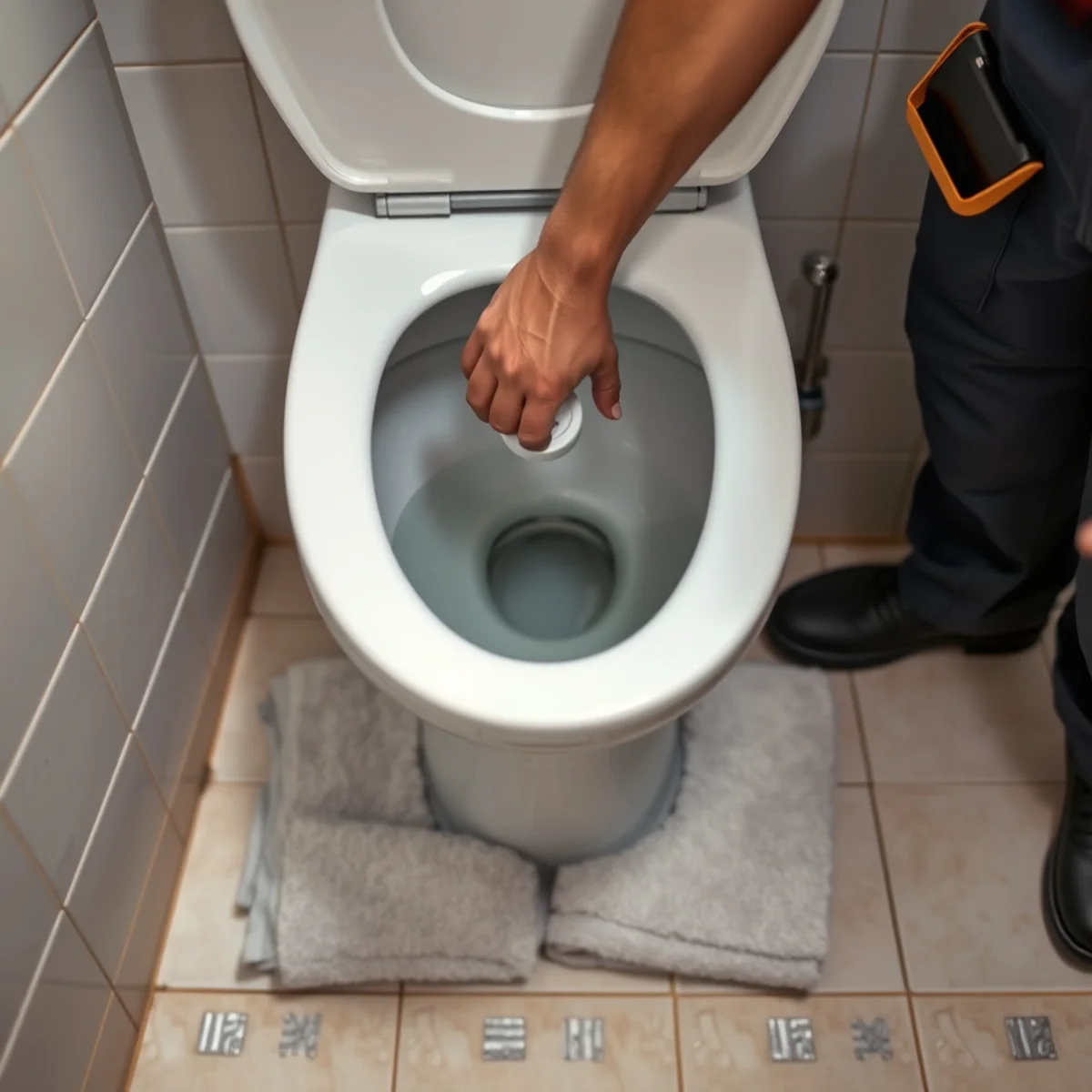
Reach behind the toilet to the angle stop on the wall — the small oval or football-shaped handle on the supply line — and turn it clockwise until it stops. If the valve is seized, which is common in older Fullerton houses with original hardware, do not force it hard enough to snap it.
The faster option: take the tank lid off and push the flapper down at the bottom of the tank with your hand. It closes the outlet immediately. Then lift the float to stop the fill valve refilling.
Do not flush again to 'clear' it. Every flush adds several more gallons to whatever is already on your floor.
Second: Is This One Toilet Or The Whole House?
This is the diagnostic minute, and it decides what happens next.
Go and run water at other fixtures. Run the bathroom sink, run the kitchen sink, flush a different toilet if you have one, and listen.
- If everything else drains normally and the overflow was clean bowl water — it is a clog in that toilet. Plunger, and if that fails, an auger.
- If other drains are slow, or one gurgles when another runs — the restriction is in the main line, not the toilet.
- If waste water came up rather than clean water — main line. Treat it as Category 3.
- If a toilet overflows when the washing machine drains, or if water comes up through a shower pan or floor drain — definitely main line, and stop using water in the house entirely.
If It Is A Main Line Backup, Stop Using Water
This is the single most important instruction on this page and it is the one people ignore.
When the main line is restricted, everything you send down finds the blockage and comes back up through the lowest opening in the house — usually a shower pan, a floor drain or the ground-floor toilet. Every load of laundry, every dishwasher cycle, every shower adds to what is on your floor.
The washing machine is the worst offender because it discharges a large volume very fast. If someone in the house starts a load without knowing what is happening, you can go from a wet bathroom to a flooded hallway in three minutes.
Tell everyone in the house. Then call a plumber for the line and a restoration company for what has already come out.
Why It Is A Biohazard, Not Just A Mess
Water that has been in the sanitary line is Category 3 under IICRC classification — black water. It carries bacteria, viruses, protozoa and fungal spores, and it soaks into porous materials within minutes.
That is why the cleanup is not a mop-and-bleach job. Porous materials that absorbed it cannot be reliably decontaminated: carpet and pad, drywall in contact with it plus a margin above the line, insulation, and particleboard cabinetry all come out. Framing, concrete, tile and hard surfaces are cleaned and then disinfected — in that order, because disinfectant applied over soil does very little.
Keep children and pets out of the affected area entirely until it is contained. Exposure risk is real, particularly for anyone immunocompromised.
What Causes Main Line Backups In Fullerton
Two causes account for most of what we see, and both track with the age of the neighbourhood.
Root intrusion is the first. Streets across Golden Hills, Chapman Woods, North Fullerton and Lemon Park were planted with ficus, sycamore, liquidambar and eucalyptus decades ago, and those root systems have had that long to find the joints in clay-tile sewer laterals installed at the same time. Roots enter at a joint, build a mat inside the pipe, and catch everything that passes.
Scale and collapse is the second. Cast iron laterals scale up internally over fifty or sixty years until the effective bore is half what it was. Add a full house over a holiday weekend and the line simply cannot pass what is sent down it.
There is also a third possibility worth knowing about: a backup in the municipal main can push waste into the lowest fixture in your house. If neighbours are having the same problem on the same day, that is what happened, and it matters for who bears the cost.
If It Was Just A Clog
Clean bowl water on a tile or vinyl floor, caught quickly, is genuinely a homeowner job. Clean it, disinfect the hard surfaces, and dry it thoroughly.
Two cautions. First, check whether water went under the flooring rather than sitting on it — vinyl and laminate trap moisture underneath, and a bathroom floor that looks fine can have a saturated subfloor. Second, if the overflow reached the base of the wall, the bottom plate and drywall may have wicked it, and that does not dry on its own behind a closed wall.
If in doubt, a moisture reading takes minutes and settles the question.
What Gets Discarded After a Sewage Overflow, and Why It Is Not Negotiable
This is the part homeowners argue with most, and it is the part with the least room for judgement. Category 3 water carries bacteria, and porous materials cannot be disinfected — the biocide reaches the surface and the contamination is already through it.
The IICRC S500 standard is explicit about this, and so is every insurance adjuster who has seen a mold claim follow a sewage cleanup that tried to save carpet. The material cost of doing it properly is almost always lower than the cost of doing it twice.
- Carpet and pad in the affected area: discarded, without exception. The pad is the reservoir and the backing cannot be sanitised through.
- Drywall: cut a minimum of twelve inches above the highest visible waterline, because wicking is always higher than the stain shows.
- Insulation behind that drywall: removed regardless of whether it looks wet — fibreglass and cellulose both hold contaminated water invisibly.
- Particleboard cabinet bases and toe kicks: swell and delaminate, and cannot be cleaned. Solid wood face frames often survive.
- Upholstered furniture and mattresses contacted by the water: discarded.
- What is usually saved: tile, sealed concrete, solid hardwood if caught fast, glass, metal, and anything non-porous that can be washed and disinfected properly.
Frequently asked
Run other fixtures. If everything else drains normally, it is a clog in that toilet. If other drains are slow, gurgle, or back up — especially when the washing machine runs — the restriction is in the main line and you should stop using water in the house immediately.
You should not. Category 3 water carries pathogens including E. coli, hepatitis A and salmonella, and household cleaning spreads contamination rather than removing it. There is also a documentation issue: a self-cleaned sewage loss becomes a disclosure problem when you sell.
Only with a water or sewer backup endorsement, which is not part of a standard homeowners policy. It typically costs a few dollars a month and is one of the best-value add-ons for any Fullerton home with an original clay lateral under mature trees.
The bottom line
Flapper down, angle stop closed, then check the other drains. That sequence tells you within a minute whether you have a small problem or a serious one.
If waste water came up, stop using water in the house and call. It is a containment job before it is a cleaning job.