
Problem Solving
Tree Roots in Your Sewer Line: Warning Signs to Catch Before the Backup
Root intrusion announces itself months in advance. Most people hear the warning and put it down to old plumbing.
The short answer
Root intrusion gives months of warning. The signals, in order: one drain slowing, then several slowing together, then gurgling when another fixture runs, then a toilet overflowing when the washing machine drains. By the time waste water surfaces, the line is effectively blocked and it is a Category 3 cleanup.
Root intrusion is one of the few plumbing failures that gives you months of notice. The problem is that the warning signs are undramatic and easy to explain away as an old house being an old house.
Here is what they actually mean, and why the mature-canopy streets in this city produce so many of them.
Dealing with this right now?
Crews dispatched within 60 minutes — on-site in 60–90 minutes, anywhere in Fullerton. Call and we will talk you through the first two minutes while a crew is dispatched.
- 60-minute dispatch, anywhere in Fullerton
- IICRC-aligned · licensed & insured
- Direct insurance documentation
The Warning Signs, In Order Of Appearance
These usually arrive in roughly this sequence over a period of months:
- One drain running slower than it used to, with no obvious cause.
- Several drains slow at the same time — the key signal, because that means the main line rather than a fixture.
- Gurgling from a shower, tub or floor drain when a different fixture runs or a toilet is flushed. That is air being displaced past an obstruction.
- A toilet whose water level drops or fluctuates on its own.
- A faint sewage smell around a floor drain, a clean-out, or in the yard above the lateral run.
- Unusually green or fast-growing grass along one line in the yard — roots have found a nutrient supply.
- Waste water surfacing in the lowest fixture in the house. At this point the line is effectively blocked.
Why It Happens Here Specifically
Two conditions have to coincide, and across much of Fullerton they do.
The first is clay-tile sewer laterals, standard practice from roughly the 1920s through the 1960s. Clay is durable — the pipe itself often outlasts everything around it — but it is laid in short sections with mortared or gasketed joints, and joints move and open over time.
The second is mature trees. Whatever was planted when a street was developed is now sixty or seventy years of root growth, and root systems extend far wider than the canopy suggests. Ficus, liquidambar, sycamore and eucalyptus are all vigorous and all common on Fullerton's older streets.
Expansive clay soil is the accelerant. It swells and shrinks with every wet and dry season, moving the pipe and opening joints that were tight when installed.
Golden Hills, Chapman Woods, North Fullerton, Lemon Park, and Alta Vista over in Placentia all have exactly this combination.
How Roots Actually Get In
They do not break the pipe. That is the common misconception and it changes how people think about the fix.
Sewer lines carry warm, nutrient-rich water and they leak a small amount of vapour at joints. Fine root hairs detect that and grow toward it. A hairline gap at a joint is enough for a root hair to enter.
Once inside, it has an unlimited supply of water and nutrients and it thrives. The fine root thickens into a mass, and that mass acts as a net — catching paper, solids and grease that would otherwise pass through.
So the pipe can be structurally intact while the line is functionally blocked, which is why a camera inspection is the only way to know what you actually have.
The Camera Inspection
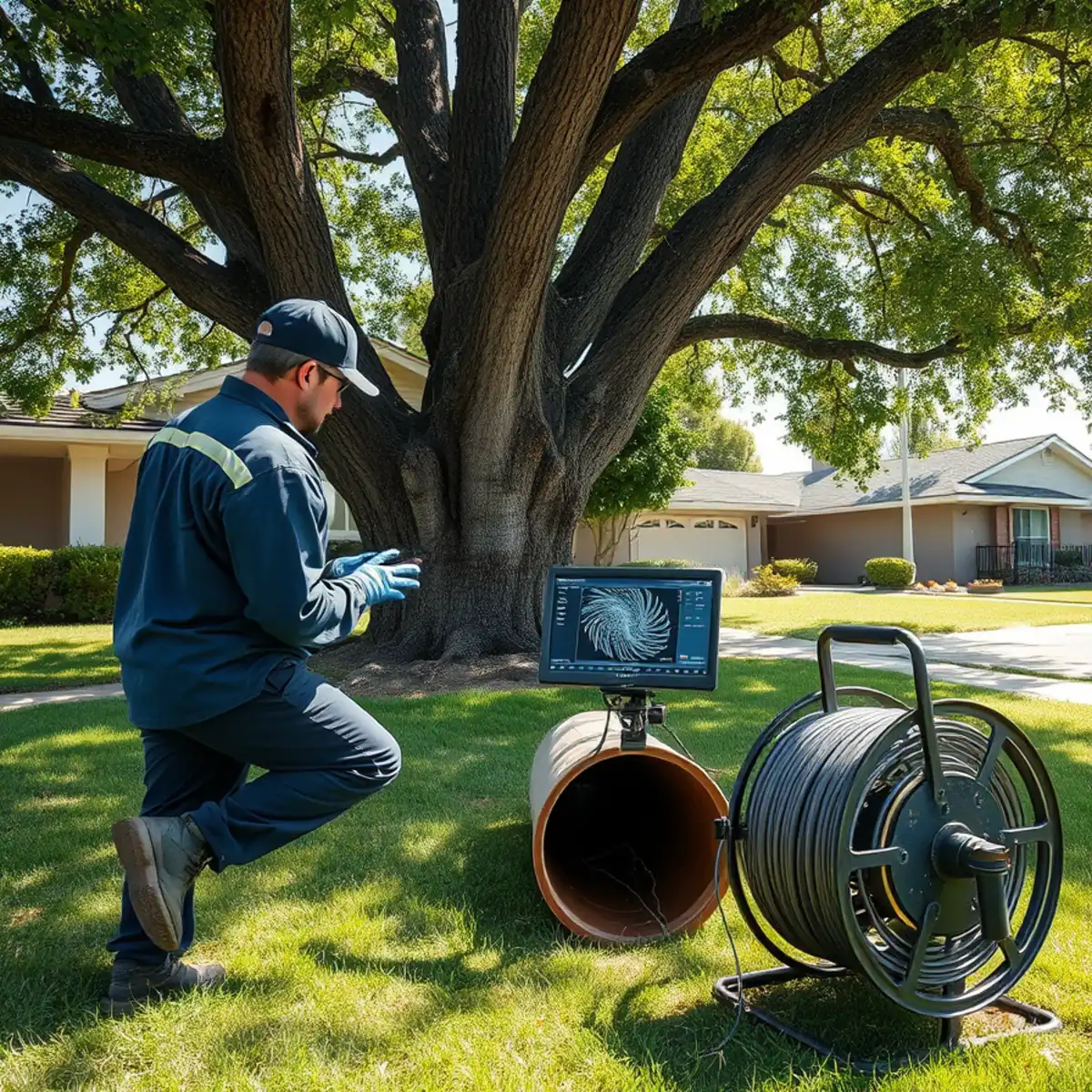
A plumber runs a camera on a flexible cable through a clean-out and down the lateral, and you watch the footage.
It shows you exactly what is there: root masses and where they enter, scale buildup, offsets where sections have shifted, bellies where the line has sagged and holds standing water, and cracks or collapses.
Typical cost is modest — well under a thousand dollars in this market and often a few hundred — against a Category 3 backup cleanup that runs into the thousands.
For any Fullerton house with an original lateral and mature street trees, doing this every few years is straightforwardly good economics. It is also worth doing before buying a house of that vintage.
The Repair Options
Mechanical clearing — a rooter or a hydro-jet — removes the root mass and restores flow. It is the immediate fix and it works, but the roots grow back, typically within one to three years depending on the species and the size of the gap.
Chemical root treatment, usually a foaming herbicide, slows regrowth between clearings. It does not repair the joint and it is a maintenance measure rather than a solution.
Pipe lining — a cured-in-place liner installed inside the existing pipe — seals the joints from the inside without excavation. It is the durable answer where the host pipe is structurally sound.
Full replacement is the answer where the line has collapsed, has significant bellies, or where lining is not viable. Most expensive, most disruptive, and permanent.
Which is right depends on what the camera shows, which is another reason to look before deciding.
Which Fullerton Trees Cause This, and What to Do About Yours
Roots do not seek out sewer lines maliciously. They follow moisture and nutrients, and a hairline crack in a clay lateral leaks both. Some species are far more aggressive about it than others, and Fullerton's mature streets are planted with several of the worst.
Removing a tree is rarely the right answer, and often not even permitted. Managing the line is.
- The usual culprits in older Fullerton neighbourhoods: ficus, liquidambar, mature eucalyptus, silver maple, willow and several ornamental fig varieties, all aggressive surface rooters.
- Distance is a poor guide. Roots routinely travel further from the trunk than the canopy is wide, so a tree two doors down can be in your lateral.
- The vulnerable material is clay tile with mortared joints, standard in Fullerton homes built before roughly 1970. ABS and PVC laterals are far less susceptible.
- Mechanical rodding clears the mat but leaves the root ends, which regrow. Hydro jetting cuts back further and clears the accumulated grease with it.
- Foaming root control products applied after clearing suppress regrowth for a season or two and are considerably cheaper than repeat emergencies.
- If a camera shows an offset joint or a belly rather than just roots, treatment is a delaying tactic. That section needs lining or replacement.
Frequently asked
Usually not. Lining or replacing the lateral solves the problem without touching the tree, and mature trees add real value to a property. Removal is worth considering only where the root system is directly under the line and repeated failures are inevitable — and that is a conversation to have after a camera inspection, not before.
Where intrusion is established, every one to three years is typical, and the camera footage will tell you which end of that range you are at. If you are clearing more often than annually, lining or replacement is the better economics.
As a maintenance measure between clearings, yes — foaming herbicides slow regrowth. They do not repair an open joint and they will not clear an established mat. Treat them as a way of extending the interval, not as a fix.
The bottom line
Multiple slow drains and gurgling are the line telling you what is coming. That warning typically arrives months ahead.
A camera inspection costs a few hundred dollars. A Category 3 backup costs thousands and puts contaminated water on your floor.