
Local Fullerton Risks
Fullerton Gets ~14 Inches of Rain — But One Storm Can Change Everything. Is Your Home Ready?
An annual average of 14 inches sounds gentle. Delivered in six storms onto saturated ground, it is not — and the fixes are mostly free.
The short answer
Fullerton averages roughly 14 inches of rain a year, but almost all of it falls between November and March in a handful of intense storms. Your house does not experience an average, it experiences the biggest storm — so clear gutters after wind season, extend downspouts, and clear area drains before the first system.
Fullerton averages roughly 14 inches of rain a year. People hear that and relax, and it is the wrong conclusion to draw.
Almost all of it falls between November and March, and within that window it arrives in a handful of intense events rather than spread across the season. Your house does not experience an average — it experiences the biggest storm.
Dealing with this right now?
Crews dispatched within 60 minutes — on-site in 60–90 minutes, anywhere in Fullerton. Call and we will talk you through the first two minutes while a crew is dispatched.
- 60-minute dispatch, anywhere in Fullerton
- IICRC-aligned · licensed & insured
- Direct insurance documentation
Why Concentration Matters More Than Total
A wet climate with 40 inches spread across 120 rain days puts modest demand on drainage at any one moment. A dry climate with 14 inches delivered in six significant storms puts enormous demand on a handful of days.
Add the compounding effect. An atmospheric river landing on ground already saturated by the previous storm means almost nothing infiltrates and almost everything runs off. The second storm of a wet week is far more dangerous than the first.
And Southern California drainage is built for exactly this — concrete channels and basins designed to move water out fast rather than absorb it. When capacity is exceeded, it is exceeded quickly rather than gradually.
The Free Half Of The Checklist
None of this costs anything except an afternoon, and it prevents most of what we get called out for:
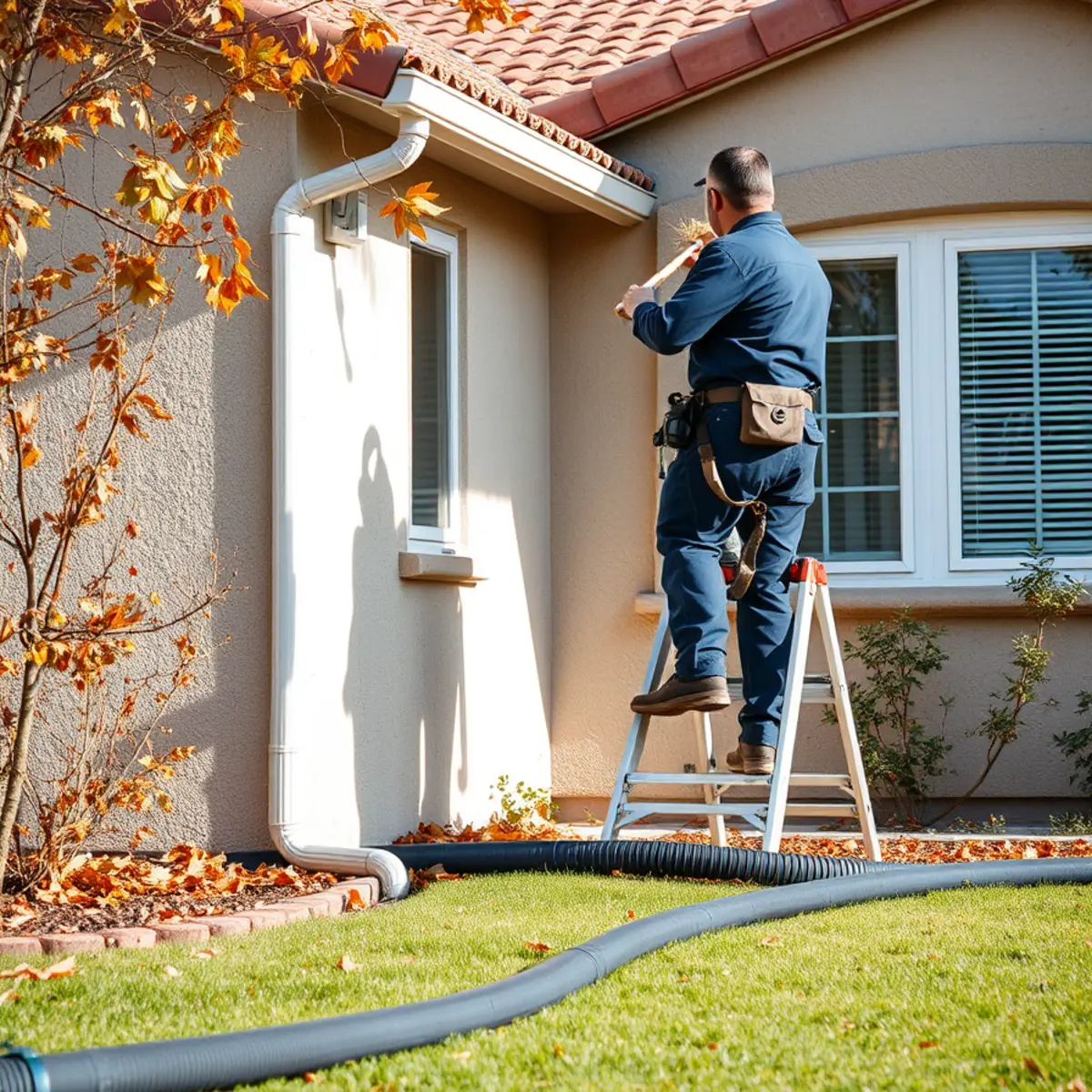
- Clear gutters and valleys, after the Santa Ana wind months rather than before. Wind loads them with leaf litter in October and November — Fullerton's mature eucalyptus, pine and pepper trees are prolific.
- Check that downspouts discharge well away from the foundation. A downspout dumping at the base of a wall is the single most common cause of the water intrusion we attend that is not a plumbing failure.
- Clear area drains and yard drains. Lift the grate, remove the silt and debris underneath, and pour a bucket of water down to confirm it actually flows.
- Walk the swale lines. On a graded lot the shallow drainage channels are there deliberately, and landscaping added over the years frequently buries or interrupts them.
- Look at the grade against the house. Soil should fall away from the foundation. Years of mulch, raised beds and hardscape often reverse it.
- Check window wells and light wells for debris, and confirm their drains are clear.
The Roof, Before The First Storm
Fullerton's seasonal sequence is wind first, rain second, and the roof is where those two meet.
Santa Ana events from October onward lift the leading edge of tiles and shingles and break the seal, frequently leaving no visible sign from the ground. The first serious storm finds every one of those gaps at once.
So walk the perimeter and look up after any significant wind. Displaced or slipped tiles, lifted shingle edges, ridge caps out of line, debris or granules in the gutters, and flashing at chimneys, skylights and roof-to-wall transitions.
If your roof is over fifteen years old, or it is tile with original underlayment approaching 25 to 30 years, an inspection in October costs a small fraction of a February ceiling restoration.
Terrain Changes The Priority
Different parts of the city need different attention, and it is worth knowing which you are.
Below a slope — Rolling Hills, the streets under Bastanchury, parts of Coyote Hills — your priority is intercepting sheet flow before it reaches the building. Swales, area drains and terrace drains, and checking that nothing installed later redirects water toward the house.
Flat ground — South Fullerton below Commonwealth, much of West Fullerton — your priority is that the street and yard drainage actually works, because there is no grade to help. Standing water at a threshold needs only inches to get inside.
Near the creek corridor — parts of East Fullerton and around Coyote Hills — add the insurance question, because flood coverage is separate and has a waiting period.
Raised foundation homes — Downtown Fullerton, Lemon Park, parts of North Fullerton — check crawl space vents and make sure water is not being channelled toward them.
The Insurance Conversation To Have In October
Three things, and October is the month for all of them.
Flood coverage is separate from your homeowners policy and NFIP normally has a 30-day waiting period. If you want it useful in January, buy it in the autumn. Look up your FEMA zone first — it is free.
Add the water and sewer backup endorsement. Heavy rain raises groundwater and stresses sewer systems, and backups spike in storm weeks. It is a few dollars a month and it is not part of a standard policy.
And photograph the exterior of your property now, in dry weather, from several angles. Documented pre-storm condition is genuinely useful if a claim becomes contentious about what the storm did versus what was already there.
During The Storm
Two things worth doing while it is actually raining, which is when problems reveal themselves.
Walk the property mid-storm with an umbrella and watch where water actually goes. You will learn more in five minutes than in any dry-weather inspection — which downspout is overwhelmed, which area drain is not coping, where water ponds against the house.
And check the interior: ceilings, the tops of walls, window and door perimeters, and the garage. A leak that only appears during wind-driven rain from one direction is an envelope failure rather than a roof failure, and it will not show up any other way.
Note what you find and deal with it when the weather clears. Most of it will be cheap in dry weather and expensive in wet.
The Two Weeks After a Storm Matter as Much as the Prep
Preparation gets all the attention, but most of what a storm actually did to a Fullerton house shows up in the ten days afterwards, once water has finished travelling and materials have had time to react.
A short walk-through after the first real system of the season catches nearly everything while it is still small.
- Ceilings, especially at the perimeter of upstairs rooms and around any roof penetration. A stain that appears two days after the rain stopped is a slow-path leak.
- Wall bases on exterior walls, and the inside face of the garage wall shared with the house. Feel them rather than looking.
- Window and door heads and sills, where wind-driven rain gets past failed sealant that sheds ordinary rain perfectly well.
- The slab edge in the garage, and any efflorescence — the white powdery deposit that shows water has moved through the concrete.
- Outside: soil that is still soft or dark three days later, which means water is sitting rather than draining and is worth correcting before the next storm.
- And the smell test in closed rooms and closets after a few days. A musty note that was not there before the storm is the earliest signal you will get.
Frequently asked
October and early November — after the first Santa Ana events have dropped leaf litter into your gutters, and before the first significant storm. Doing it in September means clearing gutters that will refill during wind season.
Because your house experiences storms, not averages. That total arrives in a handful of intense events, and the second storm of a wet week lands on saturated ground where nothing infiltrates. Almost all the storm intrusion we attend happens on a small number of days each winter.
Downspout discharge. A downspout dumping roof water at the base of a wall is the most common non-plumbing cause of intrusion we see, and extending it away from the foundation costs almost nothing.
The bottom line
Gutters after the wind, downspouts away from the house, area drains actually flowing, and the roof looked at while it is dry.
Then walk the property during the first real storm and watch where the water goes.