
Local Fullerton Risks
Santa Ana Wind Season (Oct–Mar): How NWS Advisories Turn Into Roof Leaks in Bastanchury and Rolling Hills
The wind does the damage in October. The rain finds it in December. That gap is why so many Fullerton homeowners never connect the two.
The short answer
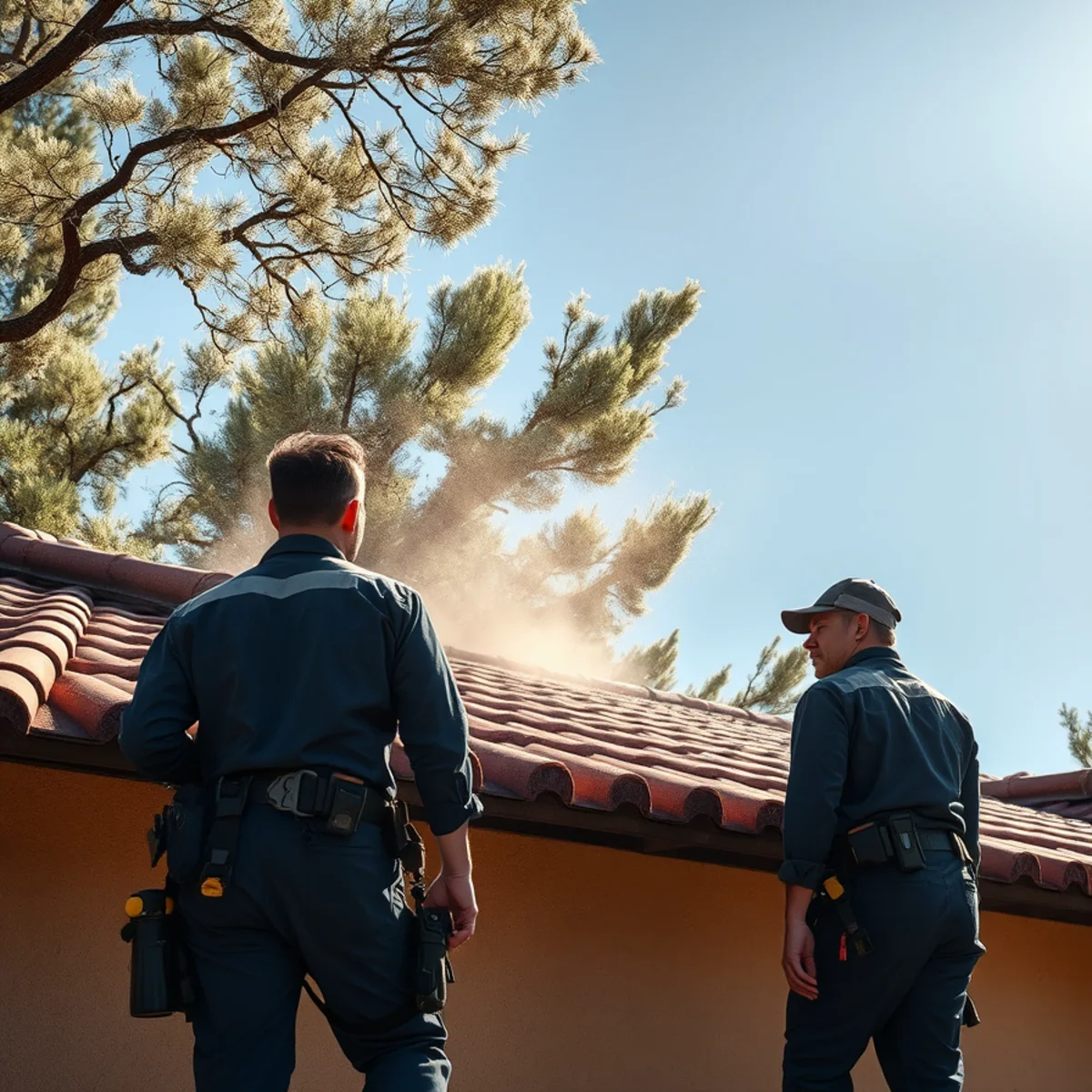
Santa Ana winds run October through March and lift the leading edge of tiles and shingles, breaking the seal without leaving visible damage from the ground. Nothing leaks at the time because the conditions are bone dry. The first serious rain then finds every one of those gaps at once, often months later.
Our roof-leak call volume does not spike during Santa Ana wind events. It spikes at the first serious rain afterwards, sometimes months later.
That delay is the reason most homeowners never link the two, and it is why so much preventable ceiling damage happens in this city every winter.
Dealing with this right now?
Crews dispatched within 60 minutes — on-site in 60–90 minutes, anywhere in Fullerton. Call and we will talk you through the first two minutes while a crew is dispatched.
- 60-minute dispatch, anywhere in Fullerton
- IICRC-aligned · licensed & insured
- Direct insurance documentation
What A Santa Ana Event Is
High pressure builds over the Great Basin, air flows toward the lower pressure at the coast, and as it descends through the mountain passes it compresses, warms and accelerates.
The result is hot, extremely dry, fast-moving offshore wind. The National Weather Service issues wind advisories and high wind warnings through the season, which runs roughly October through March with the strongest events typically from late autumn into winter.
In north Orange County these events regularly produce damaging gusts, and the effect is amplified by terrain. Elevated and exposed ground takes considerably more than sheltered flats.
In Fullerton that means Bastanchury, the highest ground in the city, along with Rolling Hills, the Coyote Hills ridge and the higher parts of Sunny Hills.
What The Wind Does To A Roof
Not what people expect. Roofs rarely come off in a Santa Ana event — the damage is subtler and far more consequential.
Wind creates uplift pressure at roof edges, eaves, ridges and corners. That pressure gets under the leading edge of tiles or shingles and lifts them.
On a shingle roof, the self-sealing adhesive strip that bonds each course to the one below breaks. On a tile roof, the tile lifts and then settles back down — frequently looking completely undisturbed from the ground.
Either way, the water barrier is compromised. Wind-driven rain can now get under the covering and reach the underlayment, and if the underlayment has aged, into the deck.
Nothing leaks at the time, because Santa Ana conditions are bone dry. The damage sits there waiting.
Then The Rain Arrives
Fullerton averages roughly 14 inches of rain a year, and almost all of it falls between November and March in a handful of intense events rather than steady drizzle.
So the first significant storm after wind season tests every seal the wind broke, all at once. That is why we get a cluster of ceiling-leak calls in the 48 hours after the first real rain, from houses that looked completely fine in October.
The intensity matters as well as the timing. An atmospheric river event delivers a large volume quickly, with wind behind it driving rain at an angle rather than vertically — which pushes water into exactly the gaps the earlier wind created.
The Tile Roof Problem Specifically
This surprises a lot of Fullerton homeowners and it is worth understanding.
On a tile roof, the tile is not the waterproofing. It is a rain shield and a wear surface. The actual water barrier is the underlayment — felt or synthetic membrane — laid on the deck underneath.
Concrete and clay tile can last fifty years or more. Underlayment typically lasts 20 to 30.
So a tile roof can look immaculate from the street and be leaking freely, because the layer that does the work has aged out while the layer you can see has not. A great many of the tile roof leaks we attend in Fullerton and the surrounding hillside neighbourhoods are exactly this.
Wind-lifted tiles that reseated themselves make it worse by removing what protection the tile was providing.
What To Check After A Wind Event
Walk the perimeter of the house and look up. You are checking from the ground, not going on the roof.
- Tiles that are visibly displaced, cracked, slipped or sitting at a different angle from their neighbours.
- Shingles lifted at the edge, curled, or with corners raised.
- Debris on the ground — tile fragments, shingle pieces, or granules washed to the bottom of downspouts.
- Ridge caps and hip tiles, which take the most uplift.
- Flashing at chimneys, skylights, vent stacks and roof-to-wall transitions.
- Gutters pulled loose, and gutters or valleys packed with leaf litter from the same wind.
The Economics Of Checking In November
A displaced tile repaired in dry weather is a small job — a roofer, an hour, a modest invoice.
The same tile discovered in February because your ceiling is stained is a different proposition entirely: roof repair, plus attic insulation removal and replacement, plus structural drying, plus ceiling drywall, texture matching and paint. Frequently mold on the roof deck as well.
There is also the insurance dimension. Damage from a specific wind event, reported promptly, is generally a covered wind loss. A ceiling with concentric ring stains showing three seasons of wetting reads as deferred maintenance to an adjuster, and those are denied routinely.
So the practical advice is simple and seasonal: after any significant wind event, walk the perimeter and look up. Photograph anything that looks wrong, and date the photographs. That is the whole intervention.
Checking a Roof After a Wind Event Without Getting On It
Nobody should be walking a tile roof after a wind event, and on a Fullerton clay tile roof an inexperienced person will break more tiles than the wind did. Almost everything worth knowing can be seen from the ground and from inside.
Do this in the week after a significant Santa Ana, while it is still dry and while a repair is a scheduled appointment rather than an emergency.
- From the ground with binoculars: look for tiles sitting proud of the course, slipped down-slope, or with a visibly different shadow line than their neighbours.
- Walk the perimeter and look for tile fragments, granules, or sections of ridge mortar on the ground. Debris below is the clearest signal of movement above.
- Check the ridge line and hip lines specifically. Mortar there cracks and lifts, and it is where wind-driven rain enters first.
- Look at all flashing intersections from below — chimney, skylight, wall abutments and vent penetrations. These are the leak points, far more than the field of the roof.
- Then go into the attic on a bright day with the light off. Daylight through the deck is a hole. Dark staining on the underside of the sheathing is a previous leak.
- Feel the top of the insulation near the eaves for compressed or damp patches, which show where water has been arriving even after it dries.
Frequently asked
If the wind was significant and your roof is over fifteen years old, yes. The characteristic damage is a broken seal rather than a missing tile, and a lifted tile that reseated itself looks perfect from the ground. An inspection in dry weather costs a fraction of a ceiling restoration in February.
Because the tile is not the waterproofing. The underlayment beneath it is, and it lasts 20 to 30 years while the tile lasts far longer. A tile roof can look immaculate and leak freely once the underlayment has aged out.
Generally yes, as is water that entered through an opening the wind created. What gets denied is a leak from an aged roof with no storm event, treated as maintenance. Report promptly, keep dated photographs from after the wind, and hold onto roofing maintenance invoices.
The bottom line
The wind breaks the seal in October. The rain finds it in December. Nobody connects the two.
Walk the perimeter after the next advisory, photograph anything odd, and get it looked at while it is still dry.