
Local Fullerton Risks
Fullerton's Aging Water Mains: Why Half the City's Pipes Are Over 50 Years Old — and What It Means for Your Home
The pipe under your street is on the same ageing curve as the pipe under your house. Here is what that means practically, and who pays when it fails.
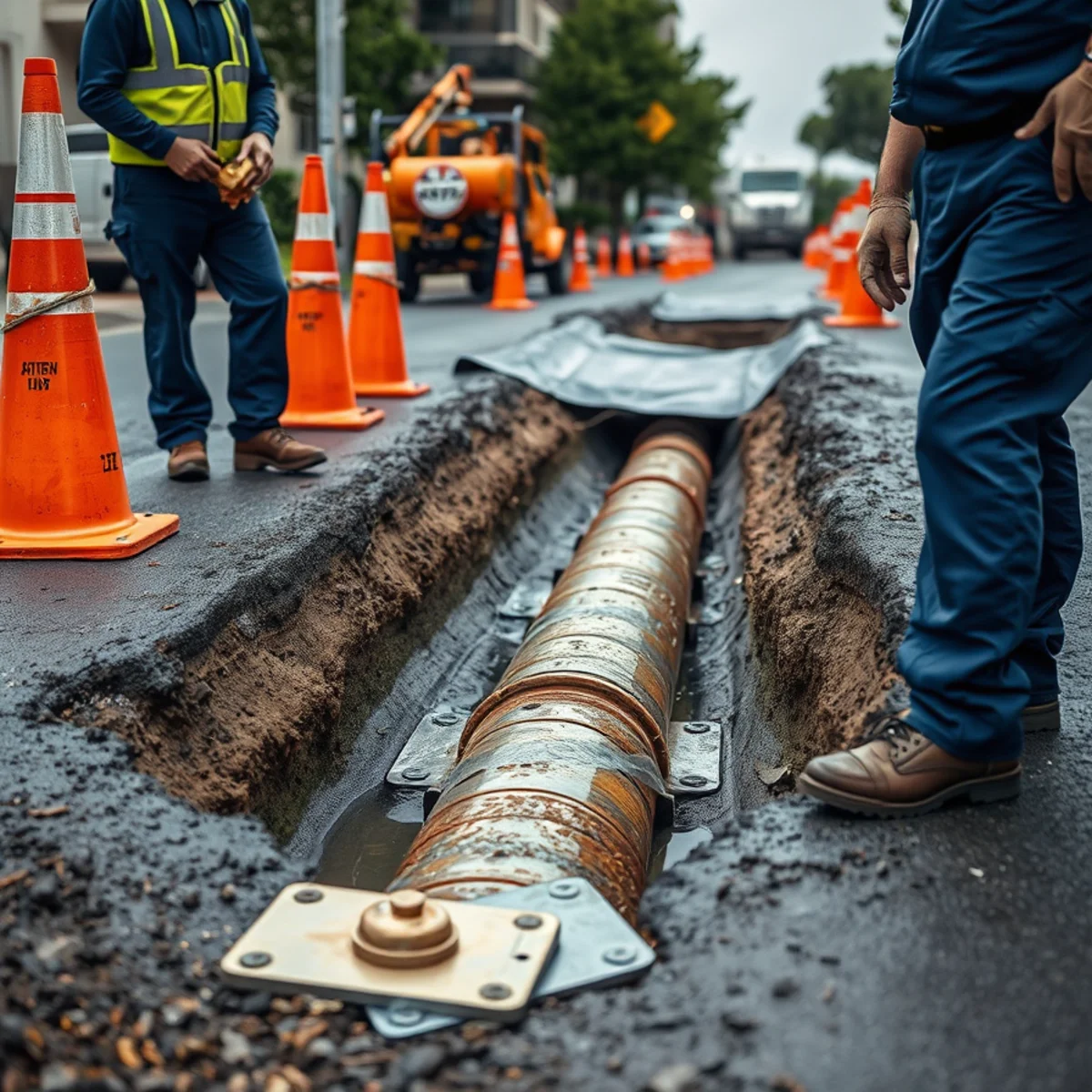
The short answer
The City of Fullerton maintains roughly 420 miles of water main and estimates around half of it is more than fifty years old. The main in the street and the plumbing in the houses around it went in at the same time, in the same soil, carrying the same hard water — and they are ageing together.
Most water damage conversations stop at the property line. They should not, because the infrastructure on the other side of it is on exactly the same ageing curve as the plumbing in your house.
The City of Fullerton maintains roughly 420 miles of water main, and by the city's own estimate around half of it is more than fifty years old.
Dealing with this right now?
Crews dispatched within 60 minutes — on-site in 60–90 minutes, anywhere in Fullerton. Call and we will talk you through the first two minutes while a crew is dispatched.
- 60-minute dispatch, anywhere in Fullerton
- IICRC-aligned · licensed & insured
- Direct insurance documentation
Why Half The System Is That Old
The arithmetic is straightforward and it is the same across post-war Southern California.
Fullerton's population expanded enormously through the 1950s and 1960s, and distribution mains were installed alongside the tract housing they served. Those mains went in over a compressed period.
Cast iron and early ductile iron mains have design lives typically quoted in the 50 to 100 year range depending on soil conditions and water chemistry. Pipe installed in 1960 is now at or past the lower end of that range.
The same expansive clay soil that stresses house slabs works on buried mains too, and Orange County's hard water does inside a municipal main much what it does inside a household pipe.
Replacement is capital-intensive and disruptive, so utilities everywhere prioritise by condition, break history and criticality rather than replacing everything at once. That is normal practice, not neglect.
What A Main Break Looks Like
Distribution mains carry water at pressures well above household levels and at much greater volume, so a failure is not a leak — it is a release.
The visible version is dramatic: water surfacing through pavement, street flooding, and in a bad case a jet of water reaching well above roof height. Those get news coverage and they are genuinely alarming for anyone living nearby.
The invisible version is more common and more insidious. A main can leak underground for a long time, saturating the surrounding soil, undermining pavement and finding its way toward whatever is downhill — which may be a garage slab or a foundation.
The signs of an underground main leak are worth knowing: persistently damp pavement or parkway with no rain, water seeping from kerbs or joints, unexplained sinkholes or depressions in the road, unusually lush grass in the parkway strip, and reduced water pressure across several neighbouring properties at once.
The Bit That Is Yours
There is a boundary and most homeowners do not know where it falls.
The main in the street is the city's. The meter is generally the city's. The service line running from the meter to your house is generally yours, including any leak in it.
That matters because service lines are often the same age as the house and made of the same materials — and in Fullerton's post-war neighbourhoods that means galvanized steel or early copper, both now well past their comfortable service life.
A service line leak shows up as a water bill increase with no change in usage, a permanently damp patch in the yard or parkway between the meter and the house, and a meter that keeps moving with the house main closed. That last test is the definitive one and it takes ten minutes.
Worth asking your agent about service line coverage. It is an inexpensive endorsement and it covers a substantial repair that most people assume the city handles.
Who Pays When A Main Break Damages Your Property
More complicated than it should be, and the answer is often not what people expect.
Municipalities in California generally have some liability protections, and a claim frequently turns on whether the city knew or should have known about a defect. A main that failed without prior indication is treated differently from one with a documented history of problems.
Practically, that means two things. File a claim with the city promptly, following their published claims procedure and within their deadlines. And notify your own homeowners carrier as well, because your policy may respond to the damage regardless of the liability question, with your insurer pursuing recovery afterwards.
Documentation decides these. Photograph everything before cleanup — the water, the source if visible, the direction of flow, the water lines on walls. Note the date and time, and note whether neighbours were affected. Multiple properties affected simultaneously is strong evidence of a public main rather than a private failure.
What It Means For Your Own Plumbing
The main is a useful proxy for the neighbourhood.
A street with mains installed in 1962 has houses with supply plumbing installed in 1962, in the same soil, carrying the same hard water. If the infrastructure under the road is at end of life, so is a lot of what is under the houses.
That is not a reason to repipe pre-emptively. It is a reason to take the early warning signs seriously in older neighbourhoods — an unexplained bill increase, a warm patch on the floor, running water audible with everything off, gradual pressure loss.
It is also a reason to rule out the city before opening your own floor. If your bill has jumped and there is a permanently damp patch in the parkway, report it before you pay for detection.
Where Your Responsibility Starts and Ends
Most homeowners do not know where the boundary falls, and it decides who pays:
- The main in the street is the city's responsibility, as is the meter itself in most cases.
- The service line running from the meter to your house is yours — including any leak in it, and the excavation to reach it.
- In Fullerton's post-war neighbourhoods that service line is often the same age and material as the house: galvanized or early copper.
- The meter isolation test settles it in ten minutes: everything off, watch the low-flow dial, then close the house main and watch again.
- Still moving with the house main closed means the leak is on your service line, not the city's main.
- Damp pavement or parkway with no rain, or neighbours with the same pressure drop, points at the city side — report it before paying for detection.
Frequently asked
In most of Fullerton it broadly tracks when the neighbourhood was built. Post-war tract areas such as Sunny Hills, Commonwealth and West Fullerton were largely developed in the 1950s and 1960s, which puts the main and the service lines feeding those houses well past fifty years. The City publishes its capital improvement schedule, and that is the authoritative answer for a specific street.
Sometimes, and it depends on the circumstances. California municipalities have some liability protections and claims often turn on prior knowledge of a defect. File with the city promptly following their published procedure, and notify your own carrier too — your policy may respond regardless while your insurer pursues recovery.
Not as standard. The buried line from the meter to your house is your responsibility, and repair involves excavation. Service line coverage is an inexpensive endorsement worth asking your agent about, particularly in the older neighbourhoods where that line is the same age and material as the house.
The bottom line
The pipe under your street and the pipe under your house went in at the same time and are ageing the same way.
Know where the boundary falls, do the meter test before assuming a leak is yours, and ask about service line coverage.