
Local Fullerton Risks
Fullerton's Clay Soils and Historic Galvanized Plumbing: The Double Risk Behind Downtown's Water Damage
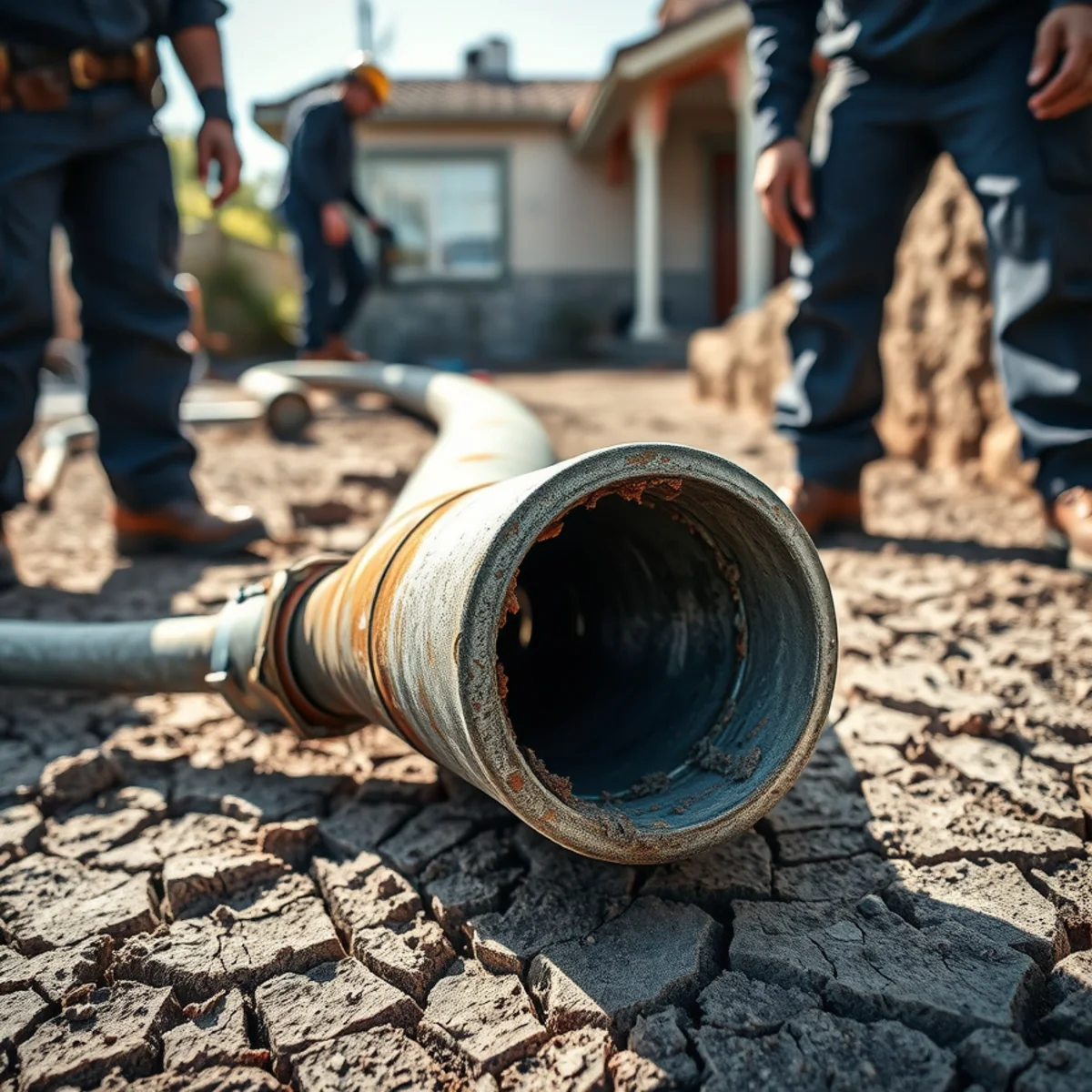
Century-old steel corroding from within, sitting in soil that moves every season. Two independent failure mechanisms, one house.
The short answer
Downtown Fullerton's 1920s–40s houses carry two independent risks at once: galvanized steel supply pipe corroding from the inside after a century, and expansive clay soil that swells and shrinks each season, stressing the rigid joints that corrosion has already thinned.
The 1920s to 1940s houses around Downtown Fullerton, Lemon Park and the Heritage streets are the best-built housing in the city and the most demanding to restore.
They also carry two independent water risks at once — one inside the pipes and one under the building — and understanding both is how you avoid being surprised by either.
Dealing with this right now?
Crews dispatched within 60 minutes — on-site in 60–90 minutes, anywhere in Fullerton. Call and we will talk you through the first two minutes while a crew is dispatched.
- 60-minute dispatch, anywhere in Fullerton
- IICRC-aligned · licensed & insured
- Direct insurance documentation
Risk One: Galvanized Steel At A Century
Galvanized steel was standard residential supply pipe from roughly the 1920s through the 1950s. It is steel pipe dipped in zinc, and the zinc is what protects it.
The zinc layer is consumed over time. Once it is gone, the steel beneath begins to corrode, and it corrodes from the inside where the water is.
Rust and mineral scale build up on the inner wall. The effective bore narrows — a half-inch pipe can end up with a quarter-inch of usable diameter — and flow becomes turbulent. Turbulence accelerates the corrosion, which narrows it further. It compounds.
Eventually the wall thins to the point where it weeps at a joint or along a seam, and then splits. The characteristic timeline is a slow weep for weeks or months, then failure.
In a century-old house, whatever original galvanized survives is well past the end of its design life.
The Warning Signs, Which Arrive Years Early
Galvanized is unusually generous with warnings, and almost everyone ignores them because they arrive gradually.
Rust-coloured or brown water when a tap has stood overnight, clearing after a few seconds. That is scale coming off the inner wall.
Water pressure that has declined over years, most noticeable when two fixtures run at once. That is the bore narrowing.
Visible corrosion, flaking or crusting at threaded joints and on exposed runs in the garage or crawl space.
Hot water noticeably weaker than cold, because hot lines corrode faster.
All three of the first ones together means the system is near the end. That is not an emergency, but it is information worth acting on before it becomes one.
The Repipe-In-Stages Problem
Almost every house of this age has been partially repiped at some point — a bathroom in 1978, a kitchen in 1995, a run replaced after a failure in 2012.
That creates the second failure mode, and it is one people rarely anticipate. Where dissimilar metals meet — galvanized steel joined to copper, most commonly — galvanic corrosion attacks the junction preferentially. The less noble metal, the steel, corrodes fastest right at the joint.
A dielectric union is supposed to prevent this by isolating the two metals. Many older transitions do not have one, or have one that has failed.
The practical consequence is that a surprising share of the bursts we attend in historic housing are at a coupling rather than mid-run, and they often occur in pipe that is otherwise in reasonable condition.
Risk Two: What The Soil Does
Fullerton's expansive clay soils swell when saturated and shrink as they dry, and the cycle runs annually — wet January, bone-dry September.
For a raised-foundation house, which most of this housing stock is, the movement shows up as differential settlement: piers and footings shifting slightly relative to each other. The visible signs are seasonal door and window binding, hairline cracking at door and window corners, and floors with a perceptible slope or dip.
For plumbing, the effect is stress on rigid connections. Galvanized pipe is not flexible, and where the building moves around it, the load concentrates at threaded joints — which is exactly where corrosion has already thinned the wall.
The two mechanisms compound. Corrosion weakens the joint; soil movement stresses it; the joint fails.
Why These Houses Take Longer To Restore
Worth knowing before it happens, because it changes the expectations on a job.
Lath and plaster does not dry like drywall. Water is held in the brown coat and behind the lath, and a plaster wall can read completely dry at the surface while the assembly behind it is saturated. Drying takes longer and requires readings taken inside the assembly rather than on the face.
Old-growth douglas fir framing is considerably denser than modern lumber and gives up moisture more slowly.
Original wood flooring is frequently irreplaceable and worth real effort to save. Mat drying systems can bring cupped old-growth boards back flat — but only before they have dried in a cupped shape and been sanded.
And there are two material cautions specific to this era: textured or acoustic ceiling finishes applied before about 1980 may contain asbestos, and painted surfaces in pre-1978 homes may contain lead. Neither should be scraped, sanded or demolished without testing. Testing is inexpensive and quick.
What To Do If You Own One
Find out what you actually have. Look at exposed runs in the garage, under sinks and in the crawl space — galvanized is dull grey steel, magnetic, with threaded fittings. Copper is obvious. Many houses have both, and the transitions are the weak points.
If you have original galvanized and the warning signs, get a plumber's assessment of remaining life. Repiping a historic house is disruptive but it is a one-time event, and it removes the risk that a failure inside a plaster wall does far more damage than the plumbing itself.
Manage the soil moisture. Keeping moisture around the foundation reasonably consistent through the year — controlled irrigation rather than none in summer and saturation in winter — reduces the swell-shrink cycle. Downspouts extended away from the building help.
And know your crawl space. On a raised foundation, a leak can run for months under the house. A musty smell with no visible source is the classic sign, and the sub-area is where we look first.
The Warning Signs Galvanized Gives You, Years in Advance
Galvanized is unusually generous with warnings. Almost everyone gets used to them instead of acting:
- Rust-coloured or brown water when a tap has stood overnight, clearing after a few seconds — that is scale coming off the inner pipe wall.
- Water pressure that has quietly declined over years, most noticeable when two fixtures run at once. That is the bore narrowing.
- Visible corrosion, flaking or crusting at threaded joints and on exposed runs in the garage or crawl space.
- Hot water noticeably weaker than cold, because hot lines corrode faster than cold ones.
- Seasonal door and window binding, plus hairline cracking at door corners — that is the clay moving, not the plumbing.
- All three of the first group together means the system is near the end of its life. That is information, not an emergency — but it is worth acting on.
Frequently asked
Look at an exposed run — in the garage, under a sink, or in the crawl space. Galvanized is dull grey steel, magnetic, and uses threaded fittings that usually show corrosion. Copper is obvious by colour and uses soldered joints. Many older Fullerton houses have both, and the joints between them are the most likely failure point.
The main concern is not the steel but what accumulates in it. Corroded galvanized can release iron, which is aesthetically unpleasant rather than harmful, and older systems may have had lead-containing components at joints. If you are concerned, water testing is inexpensive and definitive.
If it still has original galvanized showing the warning signs, it is worth serious consideration. The disruption is real, but so is the risk: a failure inside a plaster wall does considerably more damage than the same failure in a drywall house, and repeated repairs to a system at end of life add up quickly.
The bottom line
Steel corroding from within, soil moving beneath, and joints where the two meet. That is the honest picture for a century-old Fullerton house.
Look at your exposed pipe this weekend, and if the warnings are there, get an assessment before the plaster decides for you.