
Local Fullerton Risks
Orange County Hard Water Is Eating Your Copper Pipes: What Fullerton Homeowners Can Do About Pinhole Leaks
The scale on your shower door is happening inside your pipes too. Here is the mechanism, which homes are in the window, and what genuinely helps.
The short answer
Orange County water runs roughly 14 to 25 grains per gallon. That mineral load deposits scale inside copper pipe, flow turns turbulent around the deposits, and pitting corrosion eats through the wall at a single point. The result is a pinhole that weeps for weeks inside a wall rather than a burst you would notice.
You can see what Orange County water does. It is the film on the shower door, the crust on the tap aerator, the spotting on glassware, and the water heater that failed at eight years instead of twelve.
The same process is happening inside your supply pipes, where you cannot see it, and in Fullerton's 1960s and 1970s housing it is the single most common cause of hidden water damage.
Dealing with this right now?
Crews dispatched within 60 minutes — on-site in 60–90 minutes, anywhere in Fullerton. Call and we will talk you through the first two minutes while a crew is dispatched.
- 60-minute dispatch, anywhere in Fullerton
- IICRC-aligned · licensed & insured
- Direct insurance documentation
What Hard Water Actually Is
Hardness is dissolved calcium and magnesium, picked up as water moves through mineral-bearing ground. It is measured in grains per gallon, and Orange County's supply runs roughly 14 to 25 — firmly in the hard to very hard range.
It is not a health issue. The minerals are harmless to drink and there is a reasonable argument they are mildly beneficial.
The problem is entirely mechanical. Dissolved minerals come out of solution and deposit on surfaces, especially where water is heated or where flow changes direction. That is scale, and inside a pipe it does not stay inert.
How Scale Turns Into A Pinhole
The sequence is consistent and it takes decades.
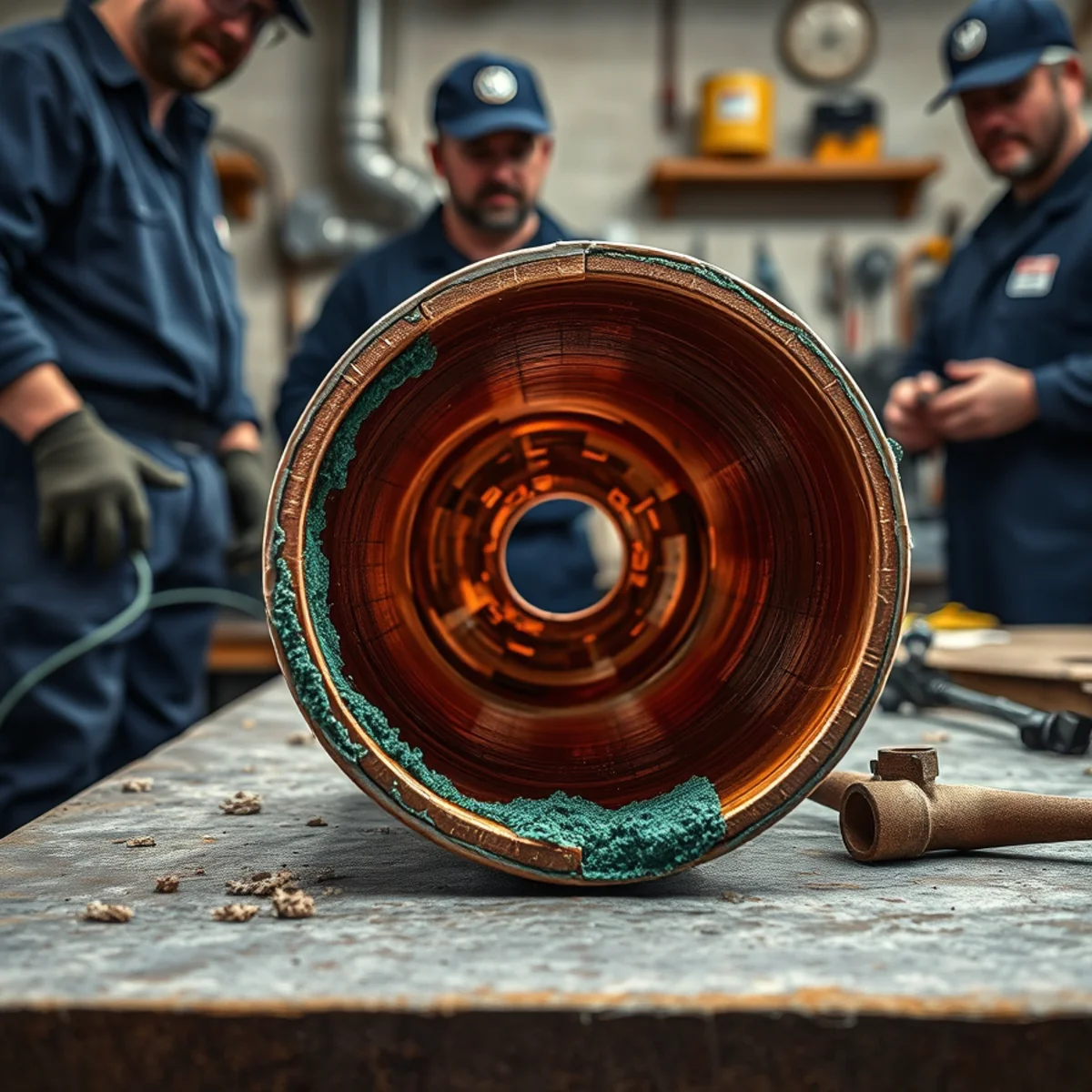
Mineral scale deposits unevenly on the inside wall of a copper pipe. Where a deposit builds, the effective bore narrows slightly and flow becomes turbulent around it rather than laminar.
Turbulence, combined with dissolved oxygen in the water, sets up a localised corrosion cell underneath and around the deposit. The copper beneath it starts to corrode preferentially — a small anodic site with the rest of the pipe acting as cathode.
That corrosion is concentrated at a point rather than spread across the surface, which is why the result is a pinhole rather than general thinning. The pipe wall is eaten through at one spot while the rest of the run is still sound.
What comes out is a weep or a fine spray. Inside a wall or under a slab, that can run for weeks or months with no visible sign at all.
Which Fullerton Homes Are In The Window
Copper became the standard residential supply material through the 1960s and 1970s, replacing galvanized steel. Those houses are now fifty to sixty-five years into the process.
Parks, Gilbert, Brookhurst and Magnolia are squarely in that band, as are large parts of West Fullerton and the 1960s tract areas of Placentia, Buena Park and Cypress.
Hot water lines are consistently first. Heat accelerates the chemistry — the deposition rate and the corrosion rate both rise with temperature — and hot lines expand and contract with every use, which adds mechanical stress the cold line never sees.
Recirculating hot water systems are the worst case of all, because water is moving through hot pipe continuously rather than intermittently.
Newer homes with modern copper or PEX are not exempt from hardness effects on fixtures and water heaters, but they are not in the pinhole failure window.
The Signs, Which Are All Indirect
You will not see a pinhole leak. You will see its consequences.
A water bill that increased with no change in usage. The sound of running water with everything off. A warm patch on a slab floor. A musty smell confined to one room. Damp or bubbling drywall at the base of a wall. Green staining or white crust on any exposed copper — that is a weep that has been evaporating and leaving mineral behind.
That last one is worth looking for specifically. Go and look at the exposed copper you can see: at the water heater, under sinks, in the garage. Green patina or white crusty deposits at a joint or along a run is corrosion in progress, and it tells you something about the condition of the pipe you cannot see.
What Actually Helps
Water softening is the main lever. Ion exchange softeners replace calcium and magnesium with sodium, which stops the scale forming. That directly addresses the deposition that drives pitting.
Salt-free conditioners work differently — they alter the crystal structure so minerals stay suspended rather than depositing. Evidence on scale prevention is reasonable; evidence on corrosion protection is weaker than for true softening.
Neither reverses damage already done. Pipe that is sixty years into pitting will continue on its trajectory. What softening does is slow further deposition, protect a new system if you repipe, and noticeably extend water heater life — which in this water is a real saving on its own.
Pressure matters too. Household pressure above about 80 psi accelerates everything and stresses fittings. A pressure regulator is inexpensive and worth checking if yours is old or absent.
And insulate hot water lines. Lower heat loss means less thermal cycling and marginally slower corrosion.
When One Pinhole Means More
This is the practical question after a first failure, and it deserves an honest answer.
Every section of pipe in the house has carried the same water for the same number of years at the same temperature. Where one point has corroded through, the rest of that run is at a similar stage.
So one pinhole in a fifty-year-old system is frequently the first rather than the last. That does not automatically mean repipe — but it does mean asking your plumber a specific question when they open the wall: what did the exposed pipe look like along its length?
Visible pitting along the section means the system is at end of life. At that point, repeated cycles of detection, repair and restoration usually cost more over a few years than repiping once.
Where to Look for Evidence Today
You will never see the pinhole itself, but the exposed copper in your house will tell you how far along the process is:
- At the water heater connections: green verdigris or white crusty mineral deposits mean a weep that has been evaporating.
- Under sinks at the angle stops: the same staining, plus any dampness on the cabinet base beneath.
- On any exposed run in the garage: look along the length, not just at the joints.
- At the shower head and tap aerators: heavy scale here is a proxy for what is depositing inside the pipe.
- In the water heater itself: rumbling or popping as it heats means sediment on the tank bottom, and a shortened life.
- Hot water lines show all of this first, because heat accelerates the chemistry and thermal cycling adds mechanical stress.
Frequently asked
It slows the process that causes them; it does not reverse existing damage. For a house with fifty-year-old copper already pitting, treat softening as mitigation. For a house being repiped, installing softening at the same time protects the new system properly.
Look at the exposed copper you can see — at the water heater, under sinks, in the garage. Green patina or white crusty mineral deposits at joints or along a run indicate a weep that has been evaporating. That is direct evidence about the condition of the pipe you cannot see.
No. Calcium and magnesium in drinking water are harmless and arguably mildly beneficial. The problem with hardness is entirely mechanical — scale on fixtures, shortened appliance and water heater life, and pitting corrosion inside copper supply lines.
The bottom line
The scale you can see on the shower door is a proxy for what is happening in the pipe you cannot.
Softening slows it, pressure regulation helps, and the exposed copper in your garage will tell you more than any general advice can.